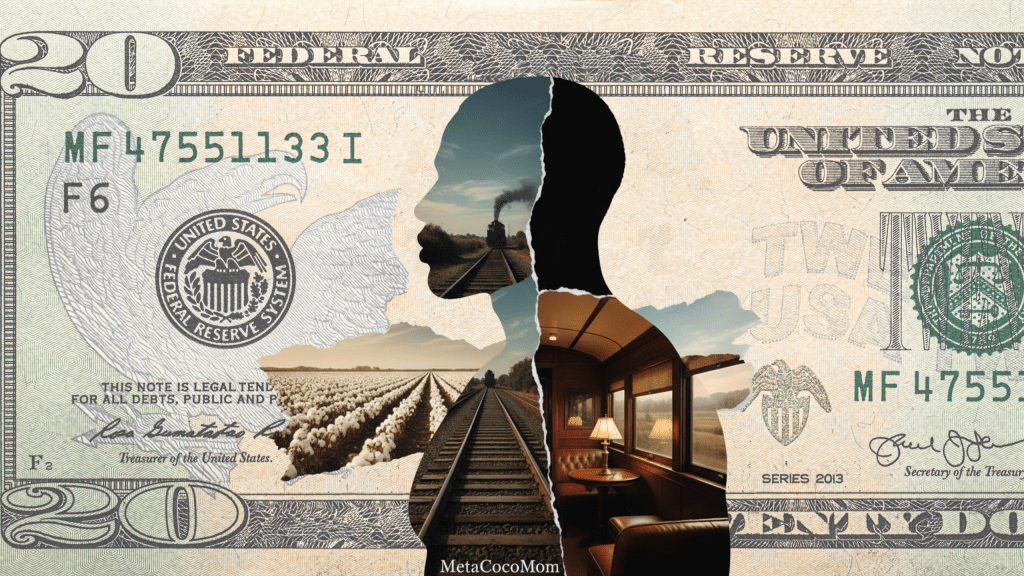
Black American folklore is not a collection of idle tales; it’s a 400-year dialogue. It is a living, breathing Call and Response.
On one side, there is the “Call” from American capitalism: a relentless set of dehumanizing narratives required to justify its most inhumane economic practices. To build a nation on the principles of “freedom” while practicing brutal exploitation, “good, law-abiding white Christians” needed to invent stories that framed the Black man as a problem to be solved, an asset to be managed, or a threat to be controlled.
On the other side, there is our “Response.”
Black folklore is our counter-narrative, the hidden transcript, the survival guide. It’s how our communities answered these brutal scripts, creating archetypes of wit, power, and humanity to navigate the system and preserve our souls. The evolution of our archetypes—from Jack to John, Mention, and Joe—is this dialectic in action.
Each figure is a direct “Response” to a specific “Call” from a new phase of American capitalism. And each reveals the bittersweet and brilliant strategies of Black resistance.
Part I: The Era of Chattel Slavery (The “Asset”)
The Capitalist “Call”: The “Savage Brute” From 1619, the primary “call” was the invention of the “savage.” To justify the economic system of chattel slavery, the Black man could not be a man. He had to be a “rapist, violent, sexually lustful brute”—a subhuman animal. This narrative was the central justification for the whip, the chain, and the auction block. It allowed “good Christians” to “own” people by framing it as “taming” a beast, absolving them of the sin of enslaving a human being.
The Folkloric “Response”: Jack the Trickster Who is he? Jack is the enslaved man who, lacking all physical power, uses his mind as his only weapon. He’s the hero of countless folktales who constantly outwits his powerful white master, the mistress, and even the devil, often to get extra food, avoid a beating, or simply reclaim a moment of his own time.Jack is a direct answer to the “brute.” He is not a creature of brawn, but of brain. He proves that the master does not own his mind, which is sharper and more cunning. But this response carried a bittersweet cost. To the white gaze, Jack’s stories (when overheard) “proved” their narrative: he was “deceitful,” “lazy,” and “criminal,” thus reinforcing the need for white brutality and control.
Part II: The Era of Spiritual Bondage (The “Soul”)
The Capitalist “Call”: Hypocritical White Christianity This “call” ran parallel to the “brute.” It was the narrative that slavery was a righteous mission to “save the heathen souls” of Africans. This provided the moral cover. The slaveholder wasn’t a kidnapper; he was a savior. It weaponized religion to sanctify the most profane economic system, telling the enslaved: “Obey your master, and you will get your reward in heaven.”
The Folkloric “Response”: High John the Conqueror Who is he? High John (or John da Conquer) is not a man, but a spirit of endurance. He is the power to “make a way out of no way.” Sometimes a magical root carried in the pocket, sometimes a mysterious stranger, he is the force of laughter, hope, and spiritual power that slavery could not kill.High John is our spiritual counter-narrative. He is the response that rejects the master’s hypocritical God. He offers a distinctly Afro-centric source of power that says: “You don’t need their heaven. You have an ancestral power right now that they can’t see and can’t destroy.” He conquers the oppressor’s spirit, not with prayer, but with magic and joy.
Part III: The Era of Jim Crow (The “Threat”)
The Capitalist “Call”: The “Freedman” Threat After emancipation, the “call” shifted. The Black man was no longer an “asset” but a “threat.” He was a “dangerous, liberated” figure who would “take over” and “endanger” white society. This narrative was the engine of the Jim Crow economy. It justified lynch law, segregation, and—most critically—convict leasing, a new form of slavery that used the prison system to rebuild the South’s infrastructure for free.
The Folkloric “Response”: Daddy Mention Who is he? Daddy Mention is the figure of the liberated prisoner, the “bad man” of folklore (like Stagolee or Railroad Bill). He is the man who has seen the inside of the brutal prison-lease system and now lives by his own rules, often outside the law, feared and respected.Daddy Mention is the response to a system where the “law” itself is the crime. He embraces the “threat” narrative and turns it into a source of defiant power. He represents the man who, having had everything taken from him by the “legal” system, is now paradoxically free from it.
Part IV: The Era of Industrialization (The “Servant”)
The Capitalist “Call”: The “Safe and Obedient Servant” The 20th-century industrial and service economy (railroads, hotels) created a new “call.” Capitalism needed Black labor in intimate white spaces without triggering the “threat” narrative. It needed the opposite of Daddy Mention: the “good,” non-threatening, asexual, and “completely obedient” Black man, a man trusted by white people. His economic value was now directly tied to his performance of this role.
The Folkloric “Response”: Daddy Joe Who is he? Daddy Joe is the archetype of the Pullman Porter. He is the pinnacle of dignified, professional service. He is perfectly mannered, impeccably dressed, and performs his subservient role with flawless precision.Unlike the other figures, Daddy Joe isn’t a purely mythical folktale character. He is a John Henry-esque myth, a composite of real men. No one documented the name of the very first Pullman Porter—he is an anonymous founder, a “Daddy Jim” as some porters called him—but his archetype became the most potent “response” of the industrial age. He plays the part capitalism has written for him so perfectly that he earns a stable, middle-class living and gains unprecedented physical mobility across a segregated nation.
The Bittersweet Taste of Resistance
This is the “bittersweet taste of Black resistance in America.” The arc from trickster to “trusted servant” looks like a painful journey from defiance to obedience. And it was painful. Survival required adopting the very masks capitalism created to justify our oppression.
But the final, brilliant “response” is this: The mask of “Daddy Joe” became the most powerful trick of all.American capitalism demanded the archetype of the obedient servant to feel safe. And in a final, profound act of Jack’s trickster genius, Black men used that very mask to plant the seeds of its undoing. The Pullman Porters, wearing the very uniform of obedience, used their “trusted” status and national mobility to become the secret arteries of the Civil Rights Movement. They smuggled newspapers like the Chicago Defender to the South, organized the first powerful Black union, and funded the movement that would challenge the very system that created them.
From Archetype to Archive: The Labor Pains Project
These archetypes—Jack, John, Daddy Mention, and Daddy Joe—appear in countless African American folktales. They chart a clear evolution of Black male adaptation and resistance to American economic systems.
What does that capitalist-folkloric call and response look like for Black American women? This is a timely question given the state of our economy, government, and culture.
My work with the Labor Pains Project is born from this question. We are creating an oral history archive to document the paid and unpaid labor experiences of Black women. As I collect these modern stories and research our folktales, I am working to find and define the female archetypes that have evolved alongside the men. What “calls” were made for Black women, and what brilliant, painful, and powerful “responses” did we create to survive?
The work of documenting our labor and our stories is the work of liberation. To follow this research and contribute to the conversation, please join the community and follow MetaCocoMom and Labor Pains Project on all social media platforms.


Leave a comment