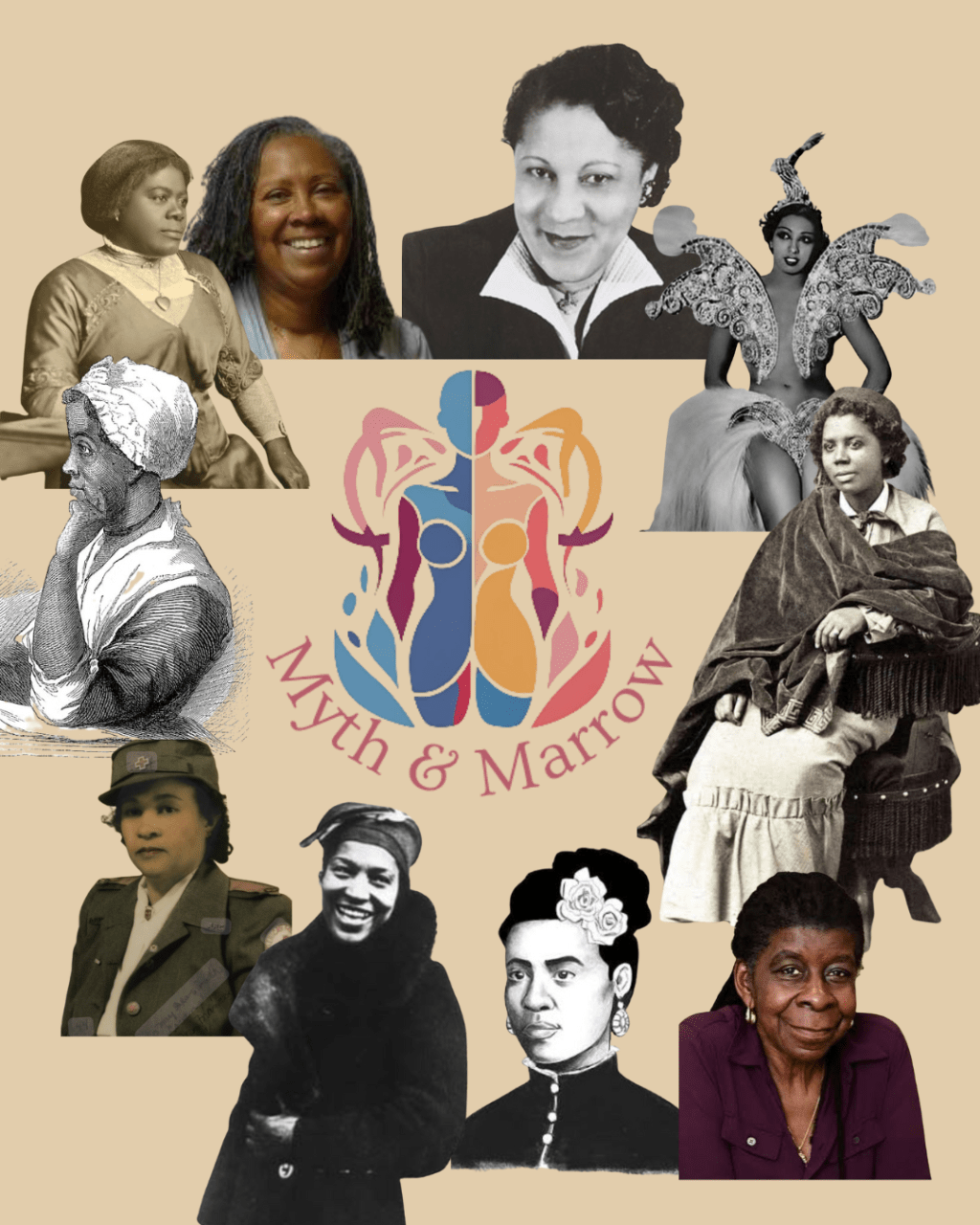
Meet the Myth & Marrow of Labor Pains
Community, it’s here.
This is one of those moments that feels electric, the kind of reveal that has been bubbling under the surface of every conversation, every Map & Meet, and every archival dive for the Labor Pains project. Today, we give our historical foundation a name and a face. Today, we introduce the Matriarchs of our Myth & Marrow.
But before I introduce these nine titans, I want to pull back the curtain on the how. These women weren’t chosen at random. They were selected through a specific, rigorous lens designed to get to the heart of our project’s central argument.
The Method to the Marrow: Our Selection Criteria
Each woman chosen for Myth & Marrow is a powerful case study. To be selected, she had to meet a demanding set of criteria that proves our thesis: that the unacknowledged labor of Black women has been the essential, subsidizing force behind American capitalism and culture. Here is the framework:
- Evidence of Multifaceted Labor: We looked for women whose work was complex, spanning both the paid and unpaid spheres. This includes their professional careers, but also their unseen domestic work, their community organizing, their emotional labor, and the intellectual work they did in private. It’s about honoring the totality of their labor.
- Evidence of Cultural Impact: Each woman had to be a “culture-shifter.” We looked for tangible proof that their work permanently altered the artistic, intellectual, or social landscape. They didn’t just participate in the culture; they actively created and defined it.
- Evidence of Impact on American Capitalism: This is the core of our argument. We asked: how did her labor interact with the American economic engine? This could be through:
- Subsidization: How did her underpaid or unpaid work (from the forced labor of enslavement to domestic and community work) create wealth and opportunity for others?
- Resistance & Creation: How did she resist economic exploitation by building her own institutions—schools, businesses, unions, and artistic movements—thereby forging pathways to Black economic autonomy?
- A Direct Geographic Anchor: Finally, each woman must have a deep, meaningful connection to our project’s two home bases: Albany, NY, or Oakland, CA. They are not just historical figures; they are local legends whose legacies still echo in the streets we walk today.
This methodology is our guide. It ensures our story is focused, powerful, and undeniable.
Now, meet the nine women who embody this framework.
The National Icons: Architects of Culture & Consciousness
- Zora Neale Hurston: The ultimate cultural preservationist, whose anthropological and literary labor reclaimed and celebrated the marrow of Black folk life.
- Phyllis Wheatley: The enslaved poet whose sheer intellectual brilliance was a revolutionary act, forcing a conversation about Black humanity in the nation’s infancy.
- Mary McLeod Bethune: The master institution-builder, whose labor in education and political organizing created a national infrastructure for Black progress and power.
- Josephine Baker: The icon whose performances were not just entertainment, but a radical reclamation of the Black body as a site of power, freedom, and global economic influence.
The Oakland Architects: Forging Community in the West
- Frances Albrier: The indomitable organizer and activist who took on unions and segregation, her labor directly bending the arc of justice and economic opportunity in the Bay Area.
- Tarea Hall Pittman: The legendary civil rights leader whose voice, broadcast across the airwaves, was a powerful tool of mass mobilization and political education for Black Oakland.
- Marion Coleman: The master quilter and griot whose creative labor stitched together the fragmented histories of the Great Migration, preserving the invaluable cultural wealth of Black life.
The Albany Pillars: Building Power in the East
- Dr. Alice Green: The relentless activist and scholar whose lifelong intellectual and political labor has been dedicated to dismantling the carceral state and fighting for racial justice in the Capital Region.
- Harriet Myers: The steadfast abolitionist whose home was a critical site of liberatory labor, a sanctuary and a hub on the Underground Railroad that represented a direct blow to the slave economy.
- Edmonia Lewis: The groundbreaking sculptor with Albany roots who physically chiseled out a space for Black women in the fine arts, turning her creativity into a viable economic path while shaping a new narrative of our dignity.
Bringing Myth & Marrow to Life
This is more than a history lesson. This is a resurrection.
The stories and methodologies behind these nine women will be transformed into the artistically designed body-maps and 3-dimensional silhouettes I’ve told you about. These visual timelines will serve as the historical chorus for the contemporary voices in our oral history collection, creating a stunning visual chronology of Black women’s impact since 1776.
And we will bring it all to you in a culminating performance that will travel from coast to coast. Prepare to witness this fusion of past and present at two incredible venues:
- Albany, NY at the Underground Railroad Education Center (UREC)
- Oakland, CA at the West Oakland Mural Project (WOMP)
Now you don’t just know the who, you know the why. This is the vision. Thank you for being a part of this electrifying journey.
With immense energy and gratitude, MetaCocoMom


Leave a comment