Redistricting, Redlining, and Racism
The “Now” (What’s Happening)
On Monday, we talked about lines. The invisible ones we carry, the imaginary ones we create, and the very real ones that dictate our lives. It turns out, some of those lines are getting a brand new coat of paint, and it’s not for curb appeal.
After a week of staring at the political Etch A Sketch that is the Texas redistricting map, I started looking closer to home. And what do I find? Ads for California’s Proposition 50, the “Election Rigging Response Act,” interrupting my precious streaming time.
The logic behind Prop 50 is, because states like Texas are busy turning their voting maps into a game of political Tetris, California needs to draw some “temporary” maps of its own to “neutralize” the mess. These maps would be in place until 2031.
The governor is pushing for a ‘yes.’ But the very people who created the independent redistricting commission I’ve come to admire are screaming ‘no.’ It seems I’ve stumbled onto a live wire, and it’s plugged directly into the third rail of our political power.
The “Then” (Where It Comes From)
If drawing lines on a map to strategically disempower Black folks sounds familiar, it’s because this is a rerun of a classic. We all know the story of redlining—how the 1930s HOLC maps marked our neighborhoods as “Hazardous,” choking off the capital needed to build generational wealth through homeownership.
But they didn’t just draw lines around us. They drew them through us.
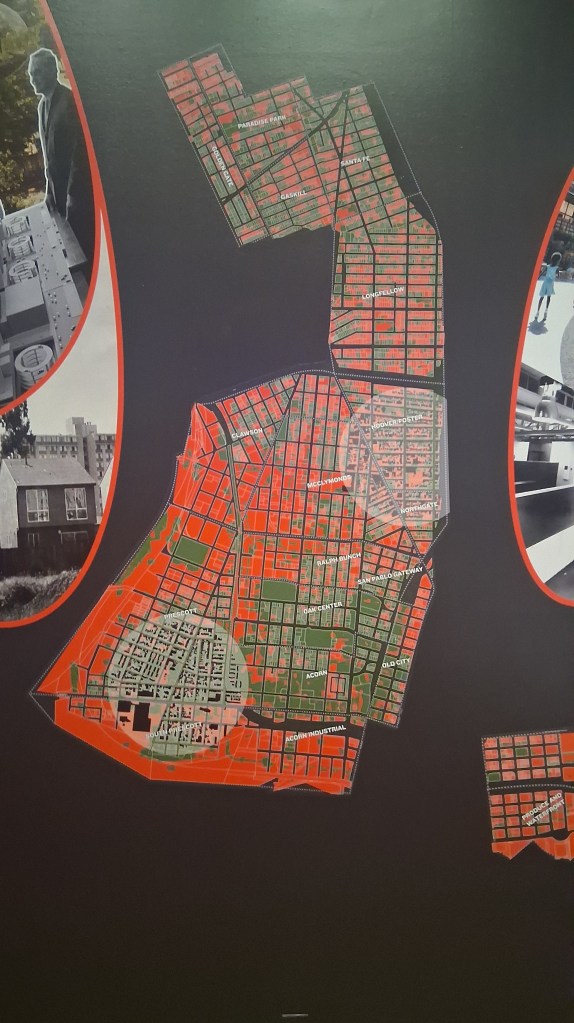
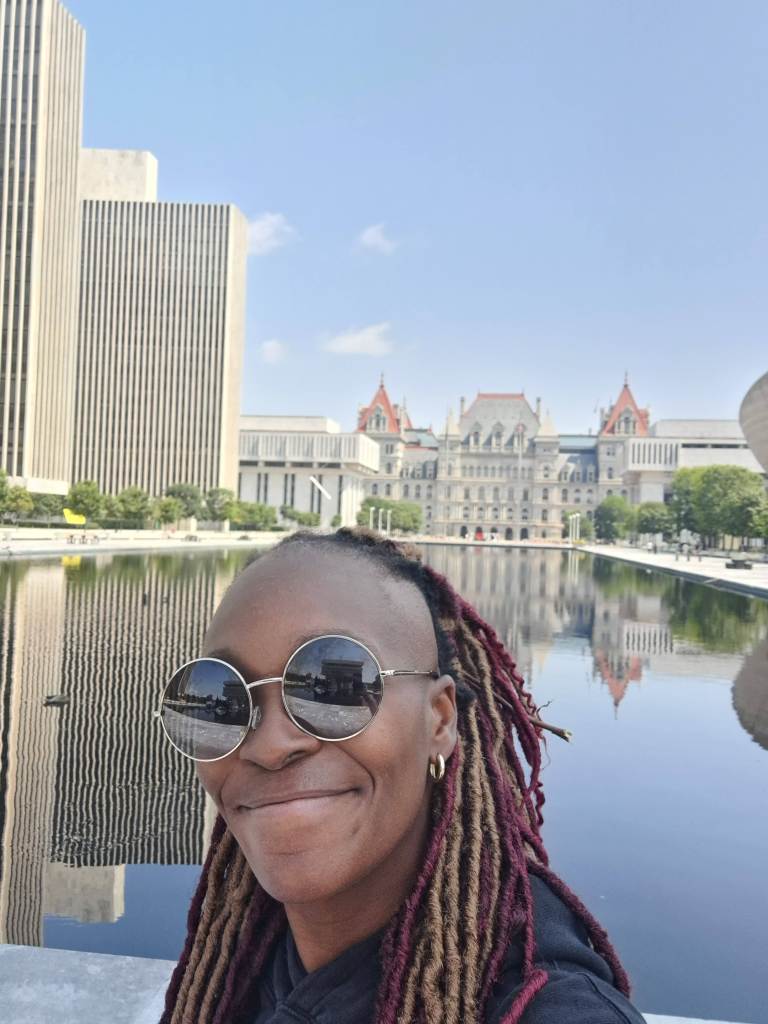
Right here in Oakland, they called our neighborhoods “slums” to justify plowing them over for Highway 17. In Albany, they leveled the South End—homes, businesses, a whole community—to build the Empire State Plaza. They called it “urban renewal,” but it was urban removal. Families were not compensated fairly. It was the literal theft of property and the figurative theft of generations of wealth that could have been.
And the politicians who pushed it all through? They leaned into the lie that Black neighborhoods were unclean and unsafe. They blamed us for not having the resources to keep our communities clean, after they systematically stripped those resources away. It’s the classic American gaslight. This country’s interest in maintaining a racial status quo to feed the engine of capitalism has always prevented it from pursuing economic policies that would benefit everyone.
The Synthesis (The Battle Cry)
Let’s connect the dots. Redlining drew a map to steal our wealth. Gerrymandering draws a map to steal our power. They are two sides of the same grimy coin, a one-two punch that leaves our communities reeling. First, you bulldoze the wealth; then, you gerrymander the political power needed to rebuild it.
And who has always stood in the gap, doing the rebuilding? Us.
For centuries, the unpaid, unseen labor of Black women has been the secret subsidy that made American capitalism possible. While the government was busy drawing lines, we were busy erasing them. Through our clubs, our churches, and our organizations—like the Phyllis Wheatley Club and the Mother’s Charity Club —we built the social safety net this country refused to provide. We ran the schools, organized healthcare, registered voters, and fought for the very soul of our communities. We provided the stability, the care, and the resilience that allowed the larger economic engine to churn, all while being denied our share of the profits.
Then came a shift. The Second New Deal began to move the responsibility for community stabilization from our shoulders to the American government. For the first time, this created a pathway for Black women to invest in ourselves. We pursued higher education. We climbed the corporate ladder. We started to build our own wealth, our own careers.
But there was a cost. As our focus turned inward and upward, our participation in those vital, community-building volunteer groups declined. The very infrastructure we had built to fight these battles started to fade, just as the fight itself was changing. Then, the “Guns and Butter” dilemma of the 1960s ran headlong into the Civil Rights Movement, putting the American government in the precarious position of having to demonstrate its national values on an international stage. From that moment forward, the government’s responsibility to its people was called into question again, this time under the guise of national security.
A government forced to choose between funding a war and funding its people. A debate over who is truly owed protection and resources.
All of this should sound terrifyingly familiar.
Which brings us to now. After the national betrayal of last November, after seeing the lines drawn and the maps redrawn, the 92% of us who showed up are tired. We are tired in our bones. It’s a historical exhaustion, a weariness passed down from generations of women who carried a nation on their backs without pay and without thanks.
And Prop 50 is on the table.


Leave a comment