
Some years ask questions. Others give answers.
– Zora Neale Hurston
Something’s been on my mind lately: dates.
Specifically, trying to pinpoint the years that marked a true pivot in American economic policy or a seismic cultural shift. These dates would provide tethers for the script I’m developing based on this research.
1776 is the obvious one, kicking things off with a laissez-faire capitalism that viewed labor as purely transactional, conveniently ignoring the unpaid labor of women and caregivers. Next I turned to 1850 and the Fugitive Slave Law, a landmark of national shame that put a bounty on Black bodies. It’s also when Black settled in West Oakland.
But based on my research, the next truly monumental year is 1935.
Ninety years later, we’re only now beginning to understand the impact of 1935 on our collective psyche, even if we can’t quite put a finger on why we feel so betrayed.
That year marked the beginning of the Second New Deal, a flurry of legislation that fundamentally altered the relationship between the American government and its people. On April 8th, the Emergency Relief Appropriation Act passed, putting millions of Americans to work through the Works Progress Administration (WPA). This is the program that funded Zora Neale Hurston’s work collecting folklore, which brought the legend of zombies from Haiti into the American popular imagination. The WPA was a declaration: the American government valued American art. It invested in artists of all kinds to document, preserve, and create a distinctly American culture.
Then came the National Labor Relations Act (the Wagner Act), which changed the rules of engagement between employers and employees. Finally, in August, the Social Security Act was passed, solidifying the government’s commitment to protecting its most vulnerable citizens. In the span of a few months, a precedent was set. American culture began to internalize the belief that our government values art, labor, and the well-being of its people.
This was a monumental connection for me. But how did this national policy play out on the ground? Especially for Black women?
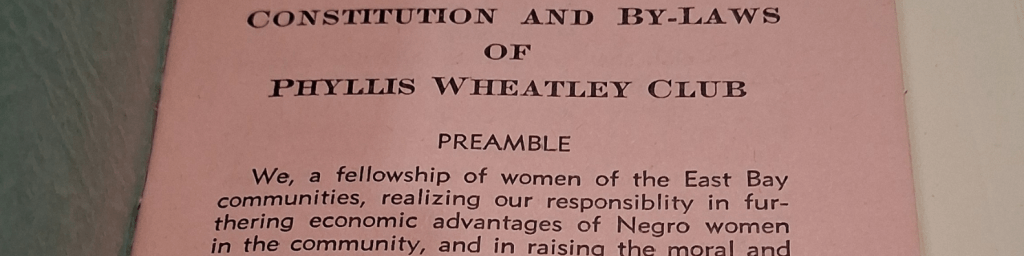
I found my answer in the archives, looking at the meeting minutes for the Phyllis Wheatley Club of the East Bay from that same year. Before the New Deal, Black women’s clubs and mutual aid societies had stepped into the gap where the government failed, providing the social safety net that the government was now claiming as its responsibility. And right there in their 1935 agenda, alongside topics like literature and political policy, was a discussion for a local senior center—a direct reflection of the new national focus on social security. Later that year, they discussed the ratings for “Negro Art,” a conversation made possible by the cultural dissemination happening under the WPA. It was crystal clear: the women of the Phyllis Wheatley Club were not just passive observers; they were actively engaging with and responding to a massive shift in national policy.
This epiphany exploded into another. If 1935, and later the Civil Rights era legislation of 1954 and 1964, built this framework of government support, what happens when it gets torn down?
Why does this feel so relevant right now?
Because of the propaganda for the “Big Beautiful Bill,” that’s why.
That pitiful, shameful law feels like it systematically undid every safety net mentioned above. Generations of Americans, myself included, feel a deep and undeniable sense of betrayal. It seems to me that this bill is a formal withdrawal of government responsibility, leaving us exposed to the harshest realities of American capitalism.
Remember how I said I was climbing the hurdle of my fear of economics? Well, to truly understand this betrayal, I had to take a look at this shameful law through the eyes of the leading economic theories. And in doing so, I’m beginning to understand why I feel the way I do.
Making Sense of the Sell-Out: Three Economic Perspectives
- The Neo-Keynesian Story: Tearing Out the Stabilizers
- Neo-Keynesians see safety nets like unemployment insurance as “automatic stabilizers.” During a recession, they automatically pump money into the economy, softening the blow.
- Their Take on the Bill: Stripping these protections is incredibly reckless. They would predict that the next downturn will be deeper and longer, with higher unemployment and poverty.
- The Bottom Line: This view validates our feeling of betrayal. The government is intentionally dismantling the very mechanisms designed to protect us in hard times, guaranteeing greater economic insecurity for all but the wealthiest.
- The Modern Monetary Theory (MMT) Story: A Political Choice, Not a Financial Necessity
- MMT argues that a government that issues its own currency (like the U.S.) can’t “run out of money.” The real limit on spending is inflation, not a budget deficit.
- Their Take on the Bill: The cuts are a purely political choice, not a financial one. The government can afford these programs; it is simply choosing not to fund them.
- The Bottom Line: This perspective makes the betrayal sting even more. It suggests the suffering caused by these cuts is entirely avoidable. The government has the tools to provide for its citizens and is actively deciding against it.
- The Monetarist Story: Unleashing the Private Sector
- Monetarists believe the government’s role should be minimal. They argue that safety nets create disincentives to work and that the private sector is more efficient.
- Their Take on the Bill: They’d likely see it as a good thing. By cutting spending and regulation, the bill “unleashes” the private sector, which they believe will lead to more growth and opportunity in the long run.
- The Bottom Line: This view frames the bill as a necessary, if difficult, reform. It challenges the narrative of betrayal, arguing that the old system created dependency while the new one fosters independence. It’s the story the bill’s proponents tell themselves.
Born in 1983, I grew up believing my American government cared about people. Sure, some more than others, but on the whole, it cared for the general welfare.
My entire adulthood has been an un-education of that lie.
My American government cares about American power. Capitalism isn’t just about money; it’s about capital. Control over capital is control, period. It’s no wonder the biggest cheerleaders for this law are the ones who want every human interaction to be a transaction. The masks are off. The American democratic experiment may be failing, but its capitalist one is thriving.
I feel like I’m standing at the edge of something, and I’m eager to dive in. My next trip to the archives is next week. Before I go, I want to look more into the policies of 1954 and 1964, and hold them right alongside the minutes, programs, and activities of the Black women’s clubs who lived through it all.
The story is there, and I’m going to find it!


Leave a comment