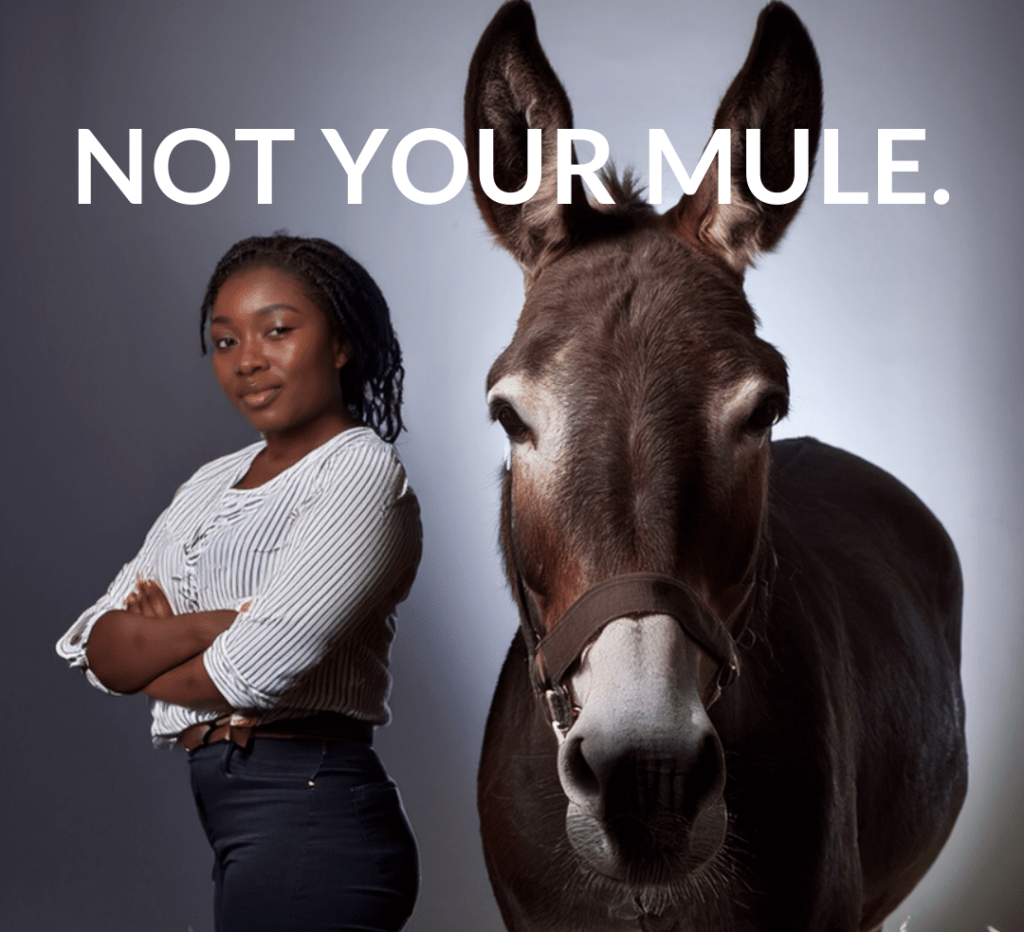
There’s a quiet revolution happening. You can see it on Instagram, in co-working spaces, and in conversations with friends. A new generation of Black women is strategically and unapologetically leaving the traditional nine-to-five hustle. We are choosing to be digital nomads, freelance thinkers, and creative entrepreneurs rather than tying ourselves to the mortgages and car payments that once defined the “American Dream.”
This exodus isn’t just a trend; it’s the Great Rejection. It is a rational and strategic choice to stop playing a game that was designed for us to lose. More than that, it is a conscious withdrawal of a subsidy that has propped up the American experiment for centuries: the paid and unpaid labor of Black women.
An Old Story, A Hidden Ledger
This isn’t a new phenomenon. The expectation that Black women will shoulder the burdens the system refuses to carry is written into our history. While recently researching the Phyllis Wheatley Club of the East Bay at the African American Museum and Library at Oakland archives, I found stunning proof in their financial ledgers from the 1930s.
During the Great Depression, club members paid monthly dues, a staggering notion for the era. Why? They were funding essential community services like sewing to maintain clothes, providing free clothes for all ages, transportation to appointments and job interviews, and providing financial aid for emergencies, free of charge.
They were building the social safety net that the government and private industry refused to create for the Black community. They were, in essence, subsidizing American capitalism with their own money and labor.
This institutional effort reflects a burden carried on the backs of individual women. The Phyllis Wheatley Club of East Bay was in operation from roughly 1914 to the mid-1990s. Named in honor of the first published African American woman poet in the country, and survivor of Transatlantic trafficking, the club was established to cultivate young Black women into a developing middle class in the Bay Area. It is one of many untold stories of the mobilization of Black women in Oakland.
As historian Michael K. Honey notes, “In a society that devalued the work of African Americans, the survival of Black families depended to a great extent on the labor of Black women.” The daily reality of this devalued labor was a constant grind under the watch of a hostile system. In the words of worker Irene Branch,
“You had a white woman over you always, and she gonna see that you work” (Honey, p.86).
The Capitalist Gaslight: Blaming the Victim
How could such a massive, ongoing economic contribution go unacknowledged and unrewarded? By design. You can’t exploit a subsidy if you admit it exists. Instead, you create a powerful counternarrative that blames the very people you are exploiting.
Enter the 1965 Moynihan Report.
Officially titled “The Negro Family: The Case for National Action,” the report was a masterclass in capitalist gaslighting. It argued that the root of Black poverty was not systemic racism or economic exploitation, but the “pathology” of the Black family itself—specifically, its “matriarchal” structure. This narrative was a gift to the status quo. It allowed the government and corporations to sidestep their responsibility. For over 50 years, this ghost has shaped policy and corporate culture, creating the expectation that Black women should work for less, endure more, and be grateful for the opportunity.
The Great Rejection
I see the legacy of this history almost daily. I speak with Black women artists who work for multiple organizations while also fulfilling roles as parents and spouses. Many are enrolled in graduate programs or pursuing other certificates, constantly bettering themselves. We are still doing the work of holding everything together. But the cost has become too great. Hence the rejection of people, places, and spaces that just don’t fit anymore. As a result, there is a stunned, passive pushback from company leaders, boards, and shareholders as they adjust to worker demands that have become unyielding, despite the economy. It has truly become a new working world order.
We are refusing to be the mules for a capitalist system that was built on our backs but never intended for our benefit. It forces a critical question: What happens to the American experiment when its primary subsidy is withdrawn?
This is the very work of the Labor Pains project. Our goal is to replace the old ghosts of blame with the living, breathing stories of our labor. We are building an oral history collection that documents the true cost of this subsidy and reveals the foundational role Black women’s work has played in the American experiment.
The old stories were well-funded. Help us fund the true ones.
Donate to Labor Pains today to support the work of telling our own story.
Citation: Honey, M. K. (2002). Black workers remember: An oral history of segregation, unionism, and the freedom struggle. University of California Press.
Archival Materials: Phyllis Wheatley Club of the East Bay records, MS 147, African American Museum & Library at Oakland, Oakland Public Library. Oakland, California.


Leave a comment