On July 8, 1984, a call about a “man going berserk” echoed from Arbor Hill to the Albany Police Department. When officers arrived, they claimed Jessie Davis, a 35-year-old Black man, lunged at them with a carving knife. They responded with five fatal bullets. Davis died in his home, a place where his neighbor had repeatedly sought help for him from the Capital District Psychiatric Center—help that never materialized. It was later discovered that Davis wasn’t armed; he held only his keys and a toy car.
This single, tragic event became a turning point for Dr. Alice Green. In a 2021 interview, she recalled how it irrevocably altered the course of her life. Already keenly aware of the intricate latticework of race, class, and poverty, the killing of Jessie Davis galvanized her. She emerged as a leading, and often critical, voice in the push for police accountability and the formation of Albany’s Community Police Review Board.
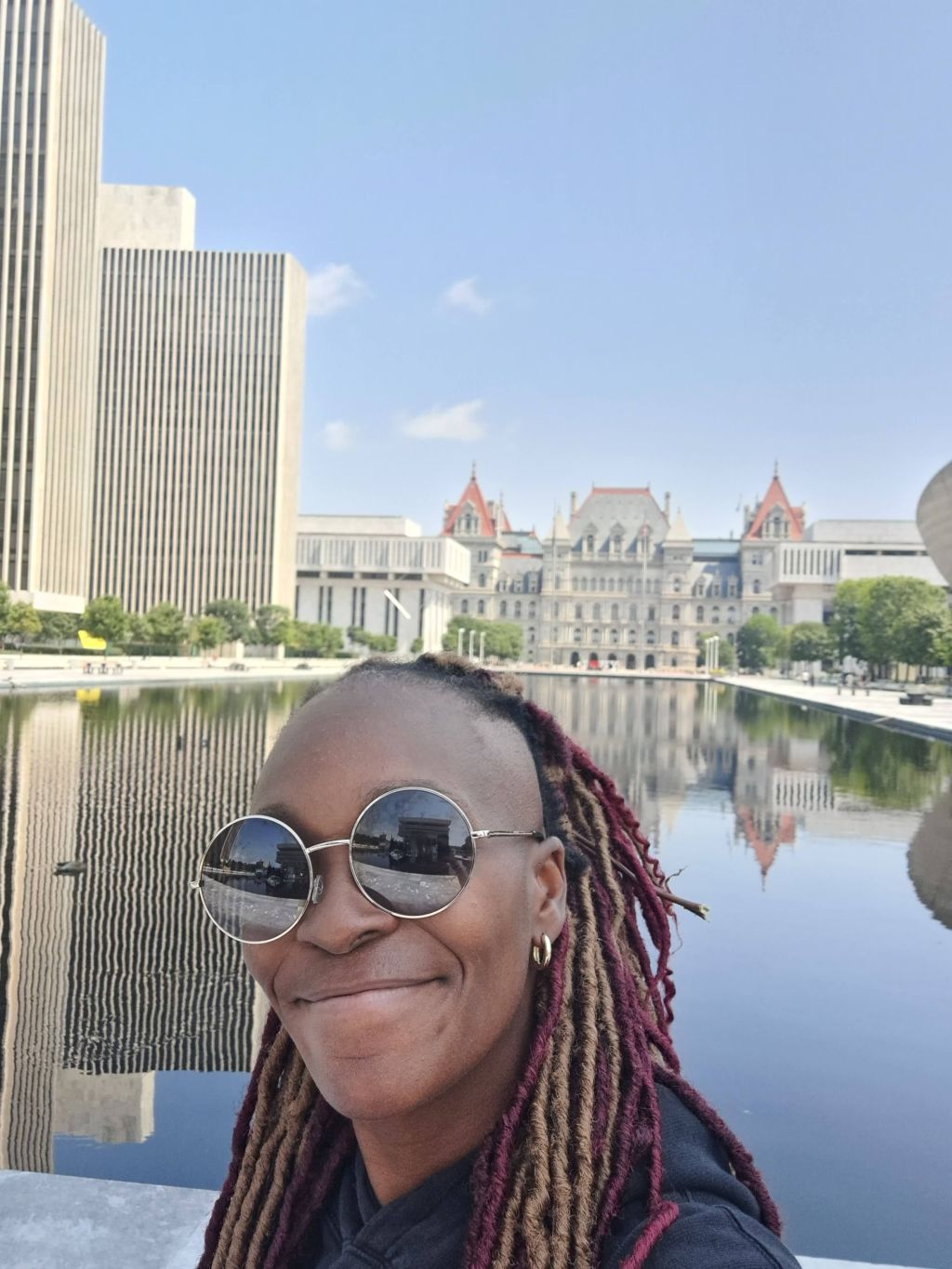
I came to the M.E. Grenander Department of Special Collections and Archives at the University at Albany today with a specific question in mind for my Labor Pains project. But as I traced Dr. Green’s fierce advocacy for Jessie Davis, for another victim of police violence, Greg Baity, and for incarcerated individuals across New York State, I found an unexpected jewel. Her story resonated so deeply that a new conviction took hold: I must reach out to her estate. I want to honor her life and immense labor by creating a body map in her memory for the project’s installation.
Popping My Research Room Cherry
My last semester of undergrad, back in 2006, I interned in the university archives, tasked with the thrilling job of digitizing old student newspapers. It was tedious, and I probably accomplished less than I should have. But I stumbled upon gems, like photos of a campus protest where students built a replica of a Vietnamese village only to burn it down, a visceral statement on the ravages of war. Looking back, those quiet, dusty afternoons were more formative than I realized. They are the reason I could get so much done remotely before even setting foot in this room.
But now, I am here. In the hushed sanctuary of the Special Collections library, ready to dig beyond the scanned headlines and into the sinew of history—the correspondence, the drafts, the speeches—to find the stories between the stories.
I signed in at my appointed time, stuffed my bookbag into a locker, and spread my laptop and notebooks across the table next to the cart of materials. I’ll admit, I felt hella official.
Then came the inevitable thought: Now, what?
Following the Threads
For all the scattered energy I bring to daily life, my projects are meticulously organized. My research question for this leg of the journey is: “How have Black women used ideals of equality, liberty, and self-determination to resist oppressive capitalism?” The Alice Green Papers felt like the perfect place to start. I wasn’t sure what I’d find or how exactly it would speak to my question. I just had to trust the process.
I’m glad I’ve learned to trust that feeling.
The story of Jessie Davis, a name I’d never encountered in my 42 years as a New Yorker, leaped from the page. From that moment forward, Dr. Green’s path was set. She became a relentless advocate, and by January 1989, she was already publicly critiquing the newly formed Community Police Review Board, arguing it lacked the teeth to enact real change within the Albany Police Department.
Her writings took me further back, into her childhood, through an essay titled, “An African in the Adirondacks.” She described growing up in Witherbee, New York, with a starkness that modern audiences might compare to District 12 in The Hunger Games, but Catholic. She wrote of the profound isolation, of her mother seeking out other Black families after their move from North Carolina, of the internalized trauma sparked by the sound of fire alarms, and of an intimate, early knowledge of inequality.
Her life’s work is a testament to the fact that the paid and unpaid labor of Black women has always been the engine of movements in American history. Her activism, her writing, her constant push against the status quo—this was her labor.
A New Phase of Research
Getting my feet wet at UAlbany has demystified the process. The initial intimidation—where do I go, what do I do?—has dissolved. As my girlfriend reminded me today, I love this. I love getting to the bottom of things. This project, Labor Pains, is my baby. I’m digging into questions that come from parts of myself I was never allowed to explore in academic settings where assignments were external and held far less heart.
Now, I have the time and space to follow these threads, to chase the breadcrumbs and see where they lead. This is what the next phase of my research looks like: sitting with the ghosts and giants of the past, reading their words, running quick searches to connect the dots, and returning home buzzing with an excitement for what tomorrow might reveal.
This work is about more than just finding answers; it’s about uncovering better questions. By supporting this project, you are helping to bring stories like Dr. Alice Green’s into the light they have long deserved. You are helping to honor the labor that has shaped our history.
I guess you’ll just have to check back in to find out what I discover next.
To support the journey of the Labor Pains project and learn how you can contribute, go to “In My Skin” Oakland workshops


Leave a comment